It’s the 4th of July, the day the United States of America signed it’s Declaration of Independence, which remains, to this day, one of the most historically important documents in the world. In honour of this important day, here, in no particular order, are five can’t-miss American sporting experiences:
A Yankees Game in the Bronx
Regrettably, a visit to Yankee Stadium in the Bronx no longer means visiting the ground graced by baseball legends like Joe DiMaggio, Babe Ruth or Lou Gehrig. The old Yankee Stadium was demolished a few years ago, in favour of a new venue that at least tries to copy the charm of the old field whilst catering to corporate types, whose facilities in Old Yankee Stadium were far behind other Major League venues.
So, Yankee Stadium is the House that Jeter Built, but the Yankees, as an organisation, have done a good job memorialising some of their – and baseball’s – biggest names. Visit Monument Park, an open-air museum beyond the centre-field fence, a wonderful place to enjoy and discover the rich history of the Yankees that contains a collection of plaques, monuments and retired numbers honoring so many legends. It’s an honour unlike many others in baseball, perhaps second only (for Yankees, anyway) to being inducted into the Pro Baseball Hall of Fame.
College football at Michigan Stadium
You haven’t seen college football until you’ve see it at Michigan Stadium! The Big House, as it’s colloquially known, is America’s largest sporting venue holds more than 113,000 souls on game days each fall, and is one of the most recognisable sporting cathedrals. It helps that the tenants, the University of Michigan Wolverines, are one of the nation’s most successful Division 1 football programs.
Even in the years when the Wolverines aren’t doing that well, seeing a game up in Ann Arbor is still one of the great sports experiences you can have. Michigan takes the usual colour and tradition that’s become synonymous with college football and raises the bar. Their student section is immense, their marching band extraordinary and their pre-game ceremony is as good as anywhere else in the country.
Michigan’s century-long tussle with Ohio State brings what is simply known as The Game to the Big House once every two years, and if you’re lucky enough to be at one of these heated contests – as I was last year – it’s a day you’ll never forget.
Any Event at Madison Square Garden
The World’s Most Famous Arena is home to an NBA franchise (the Knicks), an NHL team (the Rangers) and a WNBA outfit as well, and although both the Rangers and Knicks are perennially under-achieving and a source of great frustration to their long-suffering but rusted-on fans, simply being inside Madison Square Garden to watch a sporting contest is a must-see experience in one of America’s must-see cities.
Sitting on Broadway, right in the heart of Midtown, a circular cake tin-like structure that rises above the immense Pennsylvania Station, the Garden is crammed in with more sporting (and showbiz, for that matter) tradition than you can poke a stick at.
Yes, the moniker ‘The World’s Most Famous Arena’ is a publicist’s creation, but there’s an element of truth to it. There’s been epic boxing title fights, Michael Jordan dropped 50 on the hardwood, Wayne Gretzky lit up the ice in the latter years of his career and for so many New Yorkers the memories of the Rangers memorable run to the 1994 Stanley Cup Final will not fade anytime soon.
It almost doesn’t matter what you watch at the Garden – and there are some wonderful college hockey and basketball events sandwiched around the busy schedules of the pro teams who call the Garden home – because of the tradition. Even the most ardent, perpetually-disappointed Knicks or Rangers fan will tell you that the Garden is a magical place.
The Indianapolis 500
Yes, IndyCar racing’s national popularity has slipped into the abyss since the disastrous war for the fans between the Indy Racing League and the ChampCar World Series, from which a now-unified IndyCar Series is struggling for real prominence in the face of the NASCAR juggernaut, but there’s no mistaking the importance, tradition and continuing international impact of the Indianapolis 500, held at the Indianapolis Motor Speedway, formerly a brick pit, each May on the Sunday before Memorial Day.
There’s nothing like seeing thirty-three cars lined up in eleven rows of three coming off the final corner and down the front straight at Indianapolis, over the symbolic yard of bricks beneath the flag stand, ready to take the green. Actually, maybe there is: the moment soon after, when those cars dice and overtake heading into a tight Turn One, with fans on both sides, a veritable canyon of humanity. It’s jaw-dropping.
Although the Speedway has never published attendance numbers, best estimates from those in the know suggest that crowds on race day are upwards of 200,000 people, including permanent seating and campers spread around the 2.5-mile superspeedway on the corner of 16th and Georgetown in Speedway, Indiana. That figure, even if it’s out by a couple of thousand, still leaves the Indy 500 as the world’s biggest single-day sporting event.
Then there’s the immense tradition and prestige of winning the Indianapolis 500. Some of racing’s biggest names have triumphed at the Speedway: American icons AJ Foyt and Mario Andretti amongst them.
High school football
I’d argue that there isn’t a more quintessentially American experience than heading out on a cool Friday night to a high school to watch a game under those bright lights, sitting on cold, uncomfortable bleachers – or standing, as most people seem to do – eating a hot dog and sipping a Coke that you bought from the canteen staffed by volunteers trying to raise some more money for their school. I’ve been a part of it three times: in Virginia, Idaho and Michigan. There’s nothing like it.
In some ways, the nation’s obsession with high school football is a little weird – these are young kids we’re talking about, with enormous pressure heaped on their young shoulders – but the idea of Friday nights on the gridiron is a part of life, and it always will be.
This is particularly so in football-mad Texas, where the acclaimed and impossibly brilliant television show Friday Night Lights wasn’t exaggerating the importance of high school football in the Lone Star State, and it’s the same up in Ohio. If anything, FNL probably undersold the rabid fascination for a bunch of young kids playing on Friday nights.
In both Texas and Ohio, it isn’t uncommon for crowds that rival the size of NFL or college attendances – 40,000 and above – to turn out to high school contests.
Showing posts with label America. Show all posts
Showing posts with label America. Show all posts
Saturday, July 5, 2014

Celebrating Independence Day - My 5 Favourite Songs About America
Another Independenc Day and, specifically, the Facebook and Twitter posts that have dominated my timeline today - fireworks, Budweiser, road trips and lake-side cabins - got me thinking about some of my favourite songs about America.
Then, in my head, I tried to rank them in a Top Five. Mostly, it was unsuccessful, because, amongst a heap of epic, well-written tributes to the good (and bad) of America, putting my five favourites in any particular order isn't easy.
First, some honourable mentions:
Toby Keith - "American Soldier"
Halestorm - "American Boys"
Kenny Chesney - "I Go Back"
Kid Rock - "Born Free"
John Mellencamp - "R.O.C.K. in the USA"
Uncle Kracker - "My Hometown"
Richie Sambora - "Made In America"
Lynyrd Skynyrd - "Sweet Home Alabama"
Eric Church - "Springsteen"
Alabama - "Dixieland Delight"
Alright, here in no particular order, are my Top 5 favourite songs about the USA. Happy Birthday, America!
Key Lyric: "He's got the red, white, and blue flyin' high on the farm, Semper Fi tattooed on his left arm"
The country artist from Oklahoma is famous for his staunch patriotism and the conflict that sometimes follows with his fellow artists (most famously, the Dixie Chicks), so it made sense that Toby would honour America with a fist-pumping anthem that was the lead single from his 2011 release, Clancy's Tavern.
A sure-fire crowd-pleaser wherever Keith plays, the song strays towards the sort of arena rock, albeit with a slight country leaning, and tells the story of a farmer (a United States Marine Corps veteran) and his wife, a schoolteacher, who are fervent American patriots, bemoaning the lack of American-made products available, in comparison to imported goods.
Key Lyric: "Got in a little hometown jam, so they put a rifle in my hand. Sent me off to a foreign land, to go and kill the yellow man"
Not the pro-American anthem that most people thought it was, the title track to one of Springsteen's most popular and highest-selling albums the Boss, America's favourite working-class hero, would ever release, and certainly one of the more angry tracks on an otherwise upbeat and positive 1985 release, particularly in comparison to his previous release, the dark Nebraska.
Despite it's fist-pumping chorus (that's been used out of context ever since) "Born in the USA" is an angry song about the affects of the Vietnam War on those who went over...and those who came back from that ugly, faraway conflict a different person, unrecognisable to their friends and families. Springsteen's powerhouse delivery is as good as it gets in music.
Then, in my head, I tried to rank them in a Top Five. Mostly, it was unsuccessful, because, amongst a heap of epic, well-written tributes to the good (and bad) of America, putting my five favourites in any particular order isn't easy.
First, some honourable mentions:
Toby Keith - "American Soldier"
Halestorm - "American Boys"
Kenny Chesney - "I Go Back"
Kid Rock - "Born Free"
John Mellencamp - "R.O.C.K. in the USA"
Uncle Kracker - "My Hometown"
Richie Sambora - "Made In America"
Lynyrd Skynyrd - "Sweet Home Alabama"
Eric Church - "Springsteen"
Alabama - "Dixieland Delight"
Alright, here in no particular order, are my Top 5 favourite songs about the USA. Happy Birthday, America!
Toby Keith - "Made in America"
Key Lyric: "He's got the red, white, and blue flyin' high on the farm, Semper Fi tattooed on his left arm"
The country artist from Oklahoma is famous for his staunch patriotism and the conflict that sometimes follows with his fellow artists (most famously, the Dixie Chicks), so it made sense that Toby would honour America with a fist-pumping anthem that was the lead single from his 2011 release, Clancy's Tavern.
A sure-fire crowd-pleaser wherever Keith plays, the song strays towards the sort of arena rock, albeit with a slight country leaning, and tells the story of a farmer (a United States Marine Corps veteran) and his wife, a schoolteacher, who are fervent American patriots, bemoaning the lack of American-made products available, in comparison to imported goods.
Bruce Springsteen - "Born in the USA"
Key Lyric: "Got in a little hometown jam, so they put a rifle in my hand. Sent me off to a foreign land, to go and kill the yellow man"
Not the pro-American anthem that most people thought it was, the title track to one of Springsteen's most popular and highest-selling albums the Boss, America's favourite working-class hero, would ever release, and certainly one of the more angry tracks on an otherwise upbeat and positive 1985 release, particularly in comparison to his previous release, the dark Nebraska.
Despite it's fist-pumping chorus (that's been used out of context ever since) "Born in the USA" is an angry song about the affects of the Vietnam War on those who went over...and those who came back from that ugly, faraway conflict a different person, unrecognisable to their friends and families. Springsteen's powerhouse delivery is as good as it gets in music.
Neil Diamond - "America"
Key Lyric: "Every time that flag's unfurled, they're coming to America"
Otherwise known as "They're Coming To America", this bombastic (as only the Hot August Nights singer can sing) ode to the hundreds of thousands of immigrants who led so much strife and hardship in their own countries (particularly in Europe after the two World Wars), seeking a new beginning in the USA, which was very much seen as the Land of Opportunity in those days. Unlike some other songs on the subject, this is a positive one, with soaring choruses and strong verses. Hard not to think of Ellis Island when I listen to this one.
Arguably the most patriotic song Neil Diamond has ever written, America was originally recorded for the 1980 remake of the The Jazz Singer, and incorporates the traditional patriotic song "My Country, 'Tis of Thee" at the end.
Following the September 11, 2001 attacks on the World Trade Centre, Diamond modified the lyrics to the song when he performed it live. Instead of singing, "They're comin' to America" near the end of the song, he now sings "Stand Up For America".
Otherwise known as "They're Coming To America", this bombastic (as only the Hot August Nights singer can sing) ode to the hundreds of thousands of immigrants who led so much strife and hardship in their own countries (particularly in Europe after the two World Wars), seeking a new beginning in the USA, which was very much seen as the Land of Opportunity in those days. Unlike some other songs on the subject, this is a positive one, with soaring choruses and strong verses. Hard not to think of Ellis Island when I listen to this one.
Arguably the most patriotic song Neil Diamond has ever written, America was originally recorded for the 1980 remake of the The Jazz Singer, and incorporates the traditional patriotic song "My Country, 'Tis of Thee" at the end.
Following the September 11, 2001 attacks on the World Trade Centre, Diamond modified the lyrics to the song when he performed it live. Instead of singing, "They're comin' to America" near the end of the song, he now sings "Stand Up For America".
Brad Paisley - "Southern Comfort Zone"
Key Lyric: "Oh, Dixie Land, I hope you understand. When I
miss my Tennessee Home, and I've been away way too long, I can't
see this world unless I go, outside my Southern Comfort Zone"
I don't mind a bit of modern country, but Brad Paisley - also, a fantastic guitarist to rival anyone else going around in any genre of music at the moment - is about the furthest from modern country as there is in Nashville, so I'd never heard this song until a friend from Tennessee set me onto it.
Through an impressive video clip that takes him to a lot of places far from his southern comfort zone, Paisley spins (somewhat clichéd, but certainly still true) imagery of the southern states of America and all the things that make it so unique a sort of homesick homage from someone who's departed their southern comfort zone.
Ironically, so has the friend who turned me towards the YouTube clip. Written as a love letter from a southerner far away from everything he knows, I can see how it might make her feel.
No political motivation here, just a good, anthemic song, with an electric banjo backing that was Atkins' fifth #1 hit on the Billboard Country Charts, the song, written by Brett James & Angelo Petraglia, features Atkins talking about all the things he loves about small-town America, from kids selling lemonade from a stand outside their house, to prom nights, Chevrolet muscle cars and, of course, everyone's favourite American musical hero, Bruce Springsteen.
Yeah, maybe it's formulaic and not a particularly adventurous track lyrically, but it paints a nice picture of the best things about America, particularly in small towns from coast to coast, and is a staple on radio at this time of the year.
Through an impressive video clip that takes him to a lot of places far from his southern comfort zone, Paisley spins (somewhat clichéd, but certainly still true) imagery of the southern states of America and all the things that make it so unique a sort of homesick homage from someone who's departed their southern comfort zone.
Ironically, so has the friend who turned me towards the YouTube clip. Written as a love letter from a southerner far away from everything he knows, I can see how it might make her feel.
Rodney Atkins - "It's America"
No political motivation here, just a good, anthemic song, with an electric banjo backing that was Atkins' fifth #1 hit on the Billboard Country Charts, the song, written by Brett James & Angelo Petraglia, features Atkins talking about all the things he loves about small-town America, from kids selling lemonade from a stand outside their house, to prom nights, Chevrolet muscle cars and, of course, everyone's favourite American musical hero, Bruce Springsteen.
Yeah, maybe it's formulaic and not a particularly adventurous track lyrically, but it paints a nice picture of the best things about America, particularly in small towns from coast to coast, and is a staple on radio at this time of the year.
Saturday, July 6, 2013
Traveler Photo Gallery: Winter in Yosemite National Park
Photos from my visit to Yosemite in January 2008

Merced River along Route 140

The storm is coming

The Toyota Rav-4 that we hired at Oakland Airport. 4WD came in handy!

Yours truly on a snowy night

The morning after: no one will be using the amphitheater for a while!

El Capitan's summit partially shrouded in fog and mist

Winter Wonderland

The new snow-proof shoes came in handy!

Yosemite Lodge at the Falls

Waiting for the Yosemite Shuttle
 The Yosemite Shuttle runs in even the most inclement weather

Deer Crossing

The local deer population weren't too upset by the snow

Yosemite Falls

The snow trail to Lower Yosemite Falls

The magnificence of Tunnel View

The snow's really coming down now.

The Ahwahnee Hotel

Inside the Native American-inspired hotel

The Ahwahnee Bar: home to amazing chilli

The picturesque Yosemite Chapel

Bridalveil Fall through the trees

Bridalveil Fall

Half Dome from Yosemite Village

The Wawona Tunnel

Fir trees weighed down by snow

Yosemite Falls Shuttle Stop

The Yosemite Falls Trail

Incredible, fast-moving cloud

The snow entrance to Degnan's Deli

Sun peeking through


Half Dome from Sentinel Bridge

Our car

Wintry Tunnel View sunset

Snowy Road to Badger Pass Ski Resort


Yours truly on a snowy night

The morning after: no one will be using the amphitheater for a while!

El Capitan's summit partially shrouded in fog and mist

Winter Wonderland

The new snow-proof shoes came in handy!

Yosemite Lodge at the Falls

Waiting for the Yosemite Shuttle


Deer Crossing

The local deer population weren't too upset by the snow


Yosemite Falls

The snow trail to Lower Yosemite Falls

The magnificence of Tunnel View

The snow's really coming down now.

The Ahwahnee Hotel

Inside the Native American-inspired hotel

The Ahwahnee Bar: home to amazing chilli

The picturesque Yosemite Chapel

Bridalveil Fall through the trees

Bridalveil Fall

Half Dome from Yosemite Village

The Wawona Tunnel

Fir trees weighed down by snow

Yosemite Falls Shuttle Stop

The Yosemite Falls Trail

Incredible, fast-moving cloud

The snow entrance to Degnan's Deli

Sun peeking through

El Capitan at sunset

Half Dome from Sentinel Bridge

Our car

Wintry Tunnel View sunset

Snowy Road to Badger Pass Ski Resort
Wednesday, July 3, 2013
Traveler: Yosemite National Park
A winter adventure in the Yosemite National Park

Ever since the great nature writer John Muir trekked into the High Sierra to record his mesmerising thoughts and feelings when amongst the towering rock formations, the tumbling waterfalls and the endless acres of ancient forest, Yosemite National Park in Northern California has been a "must visit" location when on the west coast. Quite simply, there's nowhere else quite like America's first national park (thanks for that, President Theodore Roosevelt), no matter which time of the year you visit.
Winter is my favourite time of the year no matter what hemisphere I find myself in, and a winter visit to Yosemite is to see the park at it's most unforgiving. Yet, it's a beautiful sort of unforgiving: waterfalls laced with snow and ice, the high mountain passes snowed in for months at a time and virtually impossible, the twin peaks of Half Dome and El Capitan dusted with a fresh dump of snow, fast-moving cloud obscuring and then revealing, the glimpse of a deer or a lynx, fresh tracks through a field blanketed by snow, and the chilly grandeur of so many picturesque fir trees weighed down by a heavy overnight snowfall. It's postcard-perfect stuff.
If you're after solitude and isolation, winter is a good time to visit Yosemite. Gone are the crazy crowds and the warm weather of summer. Gone, too, are the leaves on the trees, and the bears into hibernation, but there's plenty to see and do. I don't think there's anything more beautiful than waking up on a still morning to see the fields and meadows covered in snow, inches deep, most of it untouched, untracked and waiting for you to explore.
Getting There
In winter, there's only one way into the park, and that's via Route 140, the main thoroughfare for visitors coming from the east, to the Arch Rock Entrance. It's the road of choice for the tour buses that make the trek daily from San Francisco. Leaving the Bay Area, you drive through the fertile Central Valley, 40-60 miles wide and 450km long, and home to some of the state's most productive agricultural areas.
The Arch Rock entrance, sitting alongside the Merced, it's gate house designed to blend on with it's natural surroundings, is literally that: you drive through a rock that sits across the road like a natural tunnel, and through the wooden huts where you pay your entrance fee, and onward.

Yosemite Village
One thing's for sure: if you're aiming to spend a lot of time in your hotel room, you needn't bother to visit Yosemite. Here, your hotel room is just the place you come back to at the end of the day, probably exhausted and elated. Everything you want to see is out there, so get out and explore it.
At the front of the Lodge is a bus stop for the Yosemite Bus that runs year-round, stopping at various attractions and hiking trail heads in the Village. Degnan's Deli, a small supermarket-type shop, and the Yosemite Post Office are nearby, as is the spectacular Visitor's Centre. Well worth stopping by, here you can find exhibitions and information on all sorts of things, from the geological beginnings of the park, to it's wildlife, the customary theatre, which screens short films about Yosemite and the High Sierra that are a must-see, of course, the customary Gift Shop, where there's just about anything Yosemite-themed that you can imagine, and probably a few things that you haven't thought of, too.

Yosemite's Shuttle Bus Service runs even in the most inclement weather
Tunnel View
Quite simply, the most breathtaking natural view that I've been fortunate enough to bear witness to in the United States of America. At the Yosemite Village end of the immense Wawona Tunnel, California State Route 41, is Tunnel View. The close-in vegetation opens up to a spectacular vista of trees, mountains and waterfalls. The south-west face of El Capitan to your left, Bridalveil Fall and Half Dome to your right, thousands of trees covering the roads and village below.
If you turn up at sunset or sunrise, especially if there's wispy traces of cloud to catch the sun's colour, the view is extra incredible. Turn up on a bluebird morning after a snowstorm has blanketed the valley, and you might never want to leave.It's hard to not take a good photo here. So, no matter what time of the day you visit, there's almost guaranteed to be a dozen people snapping photos, some with very elaborate tripod-and-lens setups.
The climb from the Valley floor seems interminable, winding through the trees, your ears popping, each bend you round not quite to the top. There's fleeting glimpses through the trees, but not enough to completely spoil the view at the lookout. Rather, just enough to whet your appetite. Then you see it, the Valley in all it's breathtaking majesty, and you're struck dumb.

From a historical standpoint, the view you see in front of you really hasn't changed much from the early days, when John Muir's writing drew so many people to Yosemite, because of the tasteful way development has been approached (in great contrast to other places in America). There's nothing so monolithic as the natural surroundings. The Ahwahnee is the only multi-storey building in the Valley, and it isn't visible from the Tunnel View. You can stand and gaze out over the view and feel much like those original Yosemite trailblazers must have felt like, a century ago.
Not surprisingly, this is one of the longer stops on the Grand Yosemite Valley Tour that leaves from the Yosemite Lodge. Transported around to all the good spots in the Valley region in a warm coach with big windows to enjoy the view out of is pretty much perfect, especially if the weather makes you not want to drive yourself. Needless to say, it's a long climb from the Village to the Tunnel View.

Behind the lookout, the Wawona Tunnel leads to the town of the same name - the Badger Pass Ski Resort is up the same road.
Badger Pass Ski Resort
Whilst not the biggest ski resort in Northern California, Badger Pass - which was owned and operated by an Aussie the last time I was there - is actually the oldest in the state, and, of course, has the distinction of being the only one in the Yosemite National Park. What you find at the end of the road is a charming ski resort, nestled into an upper nook of the park, with a half-dozen chairlifts that open up some challenging terrain, and some lovely views, too.

The thing that I liked the most, other than the reasonable lift ticket and ski hire pricing, was the complete lack of the rabid craziness that can sometimes characterise the nearby Lake Tahoe resorts. Instead, what you get is peaceful tree-filled skiing, and enough runs off each lift that you can pretty much ignore crowds, even on the busiest days. That's a big plus in my book. Like everywhere else I ski in America, the local prerogative seems to be to not lower the safety bar when going up the hill. That scares me just a little.

If you don't want to drive out from Yosemite Valley, there's a handy shuttle bus that departs the Yosemite Lodge a couple of different times each morning during the season, taking all the hassle out of the road up. Take chains (you can hire them at various service/gas stations on the way into the park) if you're making the drive yourself, and be prepared to use them, particularly close to the resort itself. The road, lined by fir trees on either side, can snow and ice over pretty quickly, and pretty unexpectedly, too.
Take it from me, you'd be doing yourself a giant favour by checking that your chains fit on your car before going up.

The Ahwahnee Hotel

There's rich history here to immerse yourself in. After all, how many hotels can lay claim to having played host to the Queen of England and a handful of US Presidents? Everyone, it seems, wants to discover and enjoy Yosemite National Park. During the Second World War, the hotel was temporarily transformed into a convalescence camp for injured US servicemen.

Your humble blogger in the Yosemite snow!
Winter is my favourite time of the year no matter what hemisphere I find myself in, and a winter visit to Yosemite is to see the park at it's most unforgiving. Yet, it's a beautiful sort of unforgiving: waterfalls laced with snow and ice, the high mountain passes snowed in for months at a time and virtually impossible, the twin peaks of Half Dome and El Capitan dusted with a fresh dump of snow, fast-moving cloud obscuring and then revealing, the glimpse of a deer or a lynx, fresh tracks through a field blanketed by snow, and the chilly grandeur of so many picturesque fir trees weighed down by a heavy overnight snowfall. It's postcard-perfect stuff.
If you're after solitude and isolation, winter is a good time to visit Yosemite. Gone are the crazy crowds and the warm weather of summer. Gone, too, are the leaves on the trees, and the bears into hibernation, but there's plenty to see and do. I don't think there's anything more beautiful than waking up on a still morning to see the fields and meadows covered in snow, inches deep, most of it untouched, untracked and waiting for you to explore.
Getting There
In winter, there's only one way into the park, and that's via Route 140, the main thoroughfare for visitors coming from the east, to the Arch Rock Entrance. It's the road of choice for the tour buses that make the trek daily from San Francisco. Leaving the Bay Area, you drive through the fertile Central Valley, 40-60 miles wide and 450km long, and home to some of the state's most productive agricultural areas.
Through Merced and Mariposa and the entrance town, El Portal, Route 140 is a beautiful road, which, at it's end, runs through the narrow valley carved out by the Merced River, whose rushing waters are littered with boulders of all shapes and sizes. On the far bank, you can see the remnants of the old stagecoach road, which used to be the only way into the park, no matter the season, a long and largely uncomfortable ride from San Francisco.
You have to look hard, because the stagecoach road has seen better days, but it's a fascinating relic of the days when traveling into America’s first national park in an automobile had probably seemed about as likely as man setting foot on the moon was likely. Now days, though, the road is in good condition, unless there's been a landslide, and the rushing water of the Merced is a brilliant backdrop, whetting your appetite for the even more impressive streams and rivers in Yosemite itself.

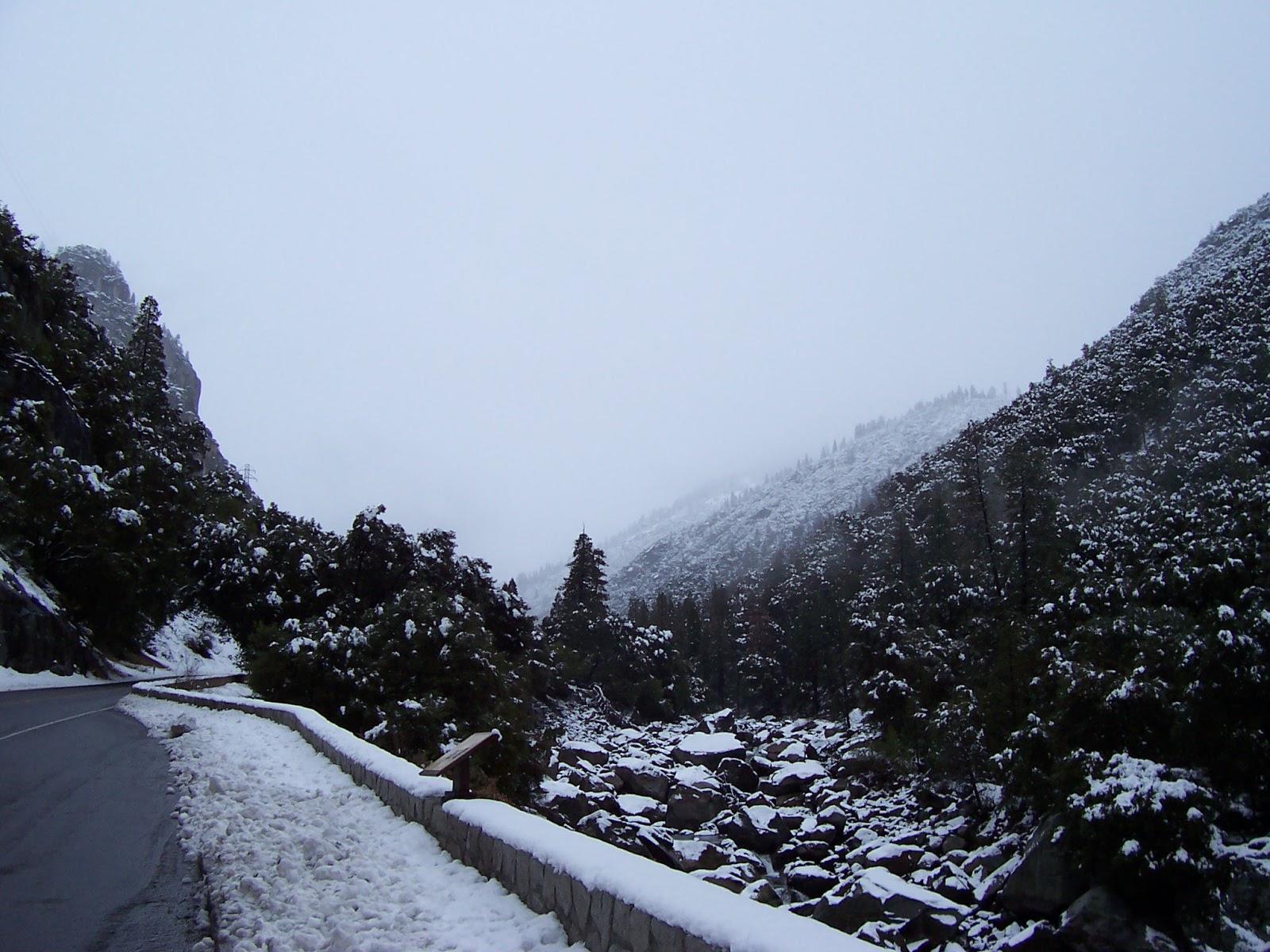
Merced River along California State Route 140
The Arch Rock entrance, sitting alongside the Merced, it's gate house designed to blend on with it's natural surroundings, is literally that: you drive through a rock that sits across the road like a natural tunnel, and through the wooden huts where you pay your entrance fee, and onward.
Our Rav-4 on Route 140
From the Arch Rock Entrance, the scenery becomes nothing short of incredible, and the closing miles of what's been a long journey from San Francisco is spellbinding. You arrive in Yosemite Valley, a gorgeous meadow, with fabulous mountains all around, the landmarks that make this national park so famous there to be enjoyed from the outset: Half Dome, El Capitan, Bridalveil Fall...
Yosemite Village
The Village, ringed on all sides by sheer granite cliffs that make you feel about an inch tall, is the main population centre in the Yosemite Valley. The focal point is the Lodge at Yosemite Falls, providing a year-round accommodation option for those on a budget. It's simple - warm rooms with beds and bathrooms, and some packages include breakfast served in the nearby eatery - but that's really all I needed.
At the front of the Lodge is a bus stop for the Yosemite Bus that runs year-round, stopping at various attractions and hiking trail heads in the Village. Degnan's Deli, a small supermarket-type shop, and the Yosemite Post Office are nearby, as is the spectacular Visitor's Centre. Well worth stopping by, here you can find exhibitions and information on all sorts of things, from the geological beginnings of the park, to it's wildlife, the customary theatre, which screens short films about Yosemite and the High Sierra that are a must-see, of course, the customary Gift Shop, where there's just about anything Yosemite-themed that you can imagine, and probably a few things that you haven't thought of, too.

Yosemite's Shuttle Bus Service runs even in the most inclement weather
Yosemite Falls
Yosemite Falls is the easiest in the park, a gentle stroll through impossibly tall trees to the base of one of the tallest and most impressive waterfalls anywhere in America. I've seen it three times: once on a beautifully sunny day when there was barely a comparative trickle of water, the second time once during the middle of an incredible snowstorm, and once on a sunny day after a recent period of heavy rain when every water way in the park was at it's best. Standing at the base of the falls, amongst the giant rocks that are strewn across the ground, feeling the cold spray in the warm sunshine is incredible. It's a very popular destination, because it's so close to the village, and because of the majesty of the scene. It's a good place to start your discovery.

Yosemite Falls is the easiest in the park, a gentle stroll through impossibly tall trees to the base of one of the tallest and most impressive waterfalls anywhere in America. I've seen it three times: once on a beautifully sunny day when there was barely a comparative trickle of water, the second time once during the middle of an incredible snowstorm, and once on a sunny day after a recent period of heavy rain when every water way in the park was at it's best. Standing at the base of the falls, amongst the giant rocks that are strewn across the ground, feeling the cold spray in the warm sunshine is incredible. It's a very popular destination, because it's so close to the village, and because of the majesty of the scene. It's a good place to start your discovery.


The snowy trail to Yosemite Falls
Quite simply, the most breathtaking natural view that I've been fortunate enough to bear witness to in the United States of America. At the Yosemite Village end of the immense Wawona Tunnel, California State Route 41, is Tunnel View. The close-in vegetation opens up to a spectacular vista of trees, mountains and waterfalls. The south-west face of El Capitan to your left, Bridalveil Fall and Half Dome to your right, thousands of trees covering the roads and village below.
If you turn up at sunset or sunrise, especially if there's wispy traces of cloud to catch the sun's colour, the view is extra incredible. Turn up on a bluebird morning after a snowstorm has blanketed the valley, and you might never want to leave.It's hard to not take a good photo here. So, no matter what time of the day you visit, there's almost guaranteed to be a dozen people snapping photos, some with very elaborate tripod-and-lens setups.
The climb from the Valley floor seems interminable, winding through the trees, your ears popping, each bend you round not quite to the top. There's fleeting glimpses through the trees, but not enough to completely spoil the view at the lookout. Rather, just enough to whet your appetite. Then you see it, the Valley in all it's breathtaking majesty, and you're struck dumb.

From Tunnel View: a dusting of snow in Yosemite Valley
From a historical standpoint, the view you see in front of you really hasn't changed much from the early days, when John Muir's writing drew so many people to Yosemite, because of the tasteful way development has been approached (in great contrast to other places in America). There's nothing so monolithic as the natural surroundings. The Ahwahnee is the only multi-storey building in the Valley, and it isn't visible from the Tunnel View. You can stand and gaze out over the view and feel much like those original Yosemite trailblazers must have felt like, a century ago.

A storm rolls in

Stunning late sunset view
Behind the lookout, the Wawona Tunnel leads to the town of the same name - the Badger Pass Ski Resort is up the same road.
Badger Pass Ski Resort
Whilst not the biggest ski resort in Northern California, Badger Pass - which was owned and operated by an Aussie the last time I was there - is actually the oldest in the state, and, of course, has the distinction of being the only one in the Yosemite National Park. What you find at the end of the road is a charming ski resort, nestled into an upper nook of the park, with a half-dozen chairlifts that open up some challenging terrain, and some lovely views, too.

Sunny morning at Badger Pass
The thing that I liked the most, other than the reasonable lift ticket and ski hire pricing, was the complete lack of the rabid craziness that can sometimes characterise the nearby Lake Tahoe resorts. Instead, what you get is peaceful tree-filled skiing, and enough runs off each lift that you can pretty much ignore crowds, even on the busiest days. That's a big plus in my book. Like everywhere else I ski in America, the local prerogative seems to be to not lower the safety bar when going up the hill. That scares me just a little.

Tree-lined runs and spectacular views: the norm
Take it from me, you'd be doing yourself a giant favour by checking that your chains fit on your car before going up.

Top of the hill
The Ahwahnee Hotel
Yosemite's more upmarket accommodation choice is the spectacular Ahwahnee Hotel, which is a short drive on from Yosemite Valley, built - almost jammed up against, even- towering granite cliffs. You can't properly imagine this hotel, and words certainly don't do it justice. It's one of those places that you just have to see for yourself. Like the rest of Yosemite National Park, really.

Designed by renowned architect Gilbert Stanley Underwood, the Ahwahnee is a marvel of a building, a charming combination of stone, concrete, wood and glass, designed to pay homage to the High Sierra's rich Native American heritage. It's a breathtaking building, and well worth a visit, even if you only get to visit the well-stocked Gift Shop,
Whilst the Ahwahnee admittedly doesn't boast the modern conveniences that you're likely to find in a hotel in a place like New York City, it certainly has a wonderful rustic, old-warm charm that envelopes you as soon as you step through the door. 
The Ahwahnee
Designed by renowned architect Gilbert Stanley Underwood, the Ahwahnee is a marvel of a building, a charming combination of stone, concrete, wood and glass, designed to pay homage to the High Sierra's rich Native American heritage. It's a breathtaking building, and well worth a visit, even if you only get to visit the well-stocked Gift Shop,

There's rich history here to immerse yourself in. After all, how many hotels can lay claim to having played host to the Queen of England and a handful of US Presidents? Everyone, it seems, wants to discover and enjoy Yosemite National Park. During the Second World War, the hotel was temporarily transformed into a convalescence camp for injured US servicemen.
Even if you can't afford to stay there - the Ahwahnee's rooms, parlors and suites aren't cheap, and nor are the meals in the fabulous dining room - there are enough public rooms downstairs that give you a wonderful feel for the place. You can sit by a fire and read a good book in one of the open lounge areas, surrounded by the understated elegance of the hotel, and no one's going to bat an eyelid.

Also worth a visit is the bar downstairs, near the hotel's main entrance. I speak from experience when I say that one of the best things you can do in Yosemite is retreat to the Ahwahnee's bar, there to enjoy a bottle of Bud and a bowl of their exceptional chilli whilst the snow falls outside. It's warm, the service is good, and the views are excellent. Certainly, there are worse places to spend a winter's afternoon. When the weather is less inclement, you can spot the squirrels running about through the meadows.

Bridalveil Fall
One of the most famous and most prominent waterfalls in the Valley, Bridalveil Fall stands at 188 tall, and flows year-round. It's one of the landmarks visible from Tunnel View, and from many other vantage points on the Valley floor, too. If you happen to be lucky, you'll see the Fall on a day when, aided by a fair breeze, the water will actually appear to be blowing sideways.

From the Valley, you can walk a half-mile from the Bridalveil Fall Parking Area. The trail is paved and leashed pets are allowed, too, but be careful for icy patches during winter.
Elsewhere...
Simply driving around Yosemite Valley is a delight in itself. It's not uncommon to have to stop for native deers crossing the road, and if you keep an eye out, even in winter, you can spot some unique wildlife. That's if you're not totally fixated on the waterfalls, high ridges and towering cliffs that you simply can't escape.

Check out the gorgeous Yosemite Chapel...drive through the empty Camp Curry (closed for the winter season)...enjoy the view of El Capitan from El Capitan meadow...go to Valley View on Northside Drive near Bridalveil Fall...stand on Sentinel Bridge and take a photo of the reflection of Half Dome in the clear water...enjoy a distant view of Yosemite Falls from Sentinel Meadow or the Yosemite Chapel.


One of the Ahwahnee's public rooms downstairs
Also worth a visit is the bar downstairs, near the hotel's main entrance. I speak from experience when I say that one of the best things you can do in Yosemite is retreat to the Ahwahnee's bar, there to enjoy a bottle of Bud and a bowl of their exceptional chilli whilst the snow falls outside. It's warm, the service is good, and the views are excellent. Certainly, there are worse places to spend a winter's afternoon. When the weather is less inclement, you can spot the squirrels running about through the meadows.

The Ahwahnee Bar
Bridalveil Fall
One of the most famous and most prominent waterfalls in the Valley, Bridalveil Fall stands at 188 tall, and flows year-round. It's one of the landmarks visible from Tunnel View, and from many other vantage points on the Valley floor, too. If you happen to be lucky, you'll see the Fall on a day when, aided by a fair breeze, the water will actually appear to be blowing sideways.

Bridalveil Fall
From the Valley, you can walk a half-mile from the Bridalveil Fall Parking Area. The trail is paved and leashed pets are allowed, too, but be careful for icy patches during winter.
Elsewhere...
Simply driving around Yosemite Valley is a delight in itself. It's not uncommon to have to stop for native deers crossing the road, and if you keep an eye out, even in winter, you can spot some unique wildlife. That's if you're not totally fixated on the waterfalls, high ridges and towering cliffs that you simply can't escape.

The picturesque - and very popular for weddings - Yosemite Chapel
Check out the gorgeous Yosemite Chapel...drive through the empty Camp Curry (closed for the winter season)...enjoy the view of El Capitan from El Capitan meadow...go to Valley View on Northside Drive near Bridalveil Fall...stand on Sentinel Bridge and take a photo of the reflection of Half Dome in the clear water...enjoy a distant view of Yosemite Falls from Sentinel Meadow or the Yosemite Chapel.

El Capitan at sunset - one of the best photos I've ever taken

Deer Crossing
Subscribe to:
Posts (Atom)